In the early stages of a construction project, coordination between disciplines is often fast-paced and fluid. Structural elements are being fixed, M&E layouts are still evolving, and the riser voids – the vertical arteries of the building – are often overlooked until late in the design process. Yet these spaces are essential to the safe and efficient routing of services throughout the structure.
Delaying their coordination or specification inevitably leads to inefficiency, additional cost, and significant site risk. Early design coordination, particularly in relation to riser management, is therefore not just good practice – it is critical to project success.
The Problem with Late Riser Design
Too often, risers are left as simple openings in floor slabs, with temporary protection and makeshift shuttering put in place until the M&E services are known. At this point, multiple trades – formwork, structural, M&E, firestopping, and finishing – must all interact in the same limited zone.
When the service layouts finally arrive, conflicts frequently emerge: penetrations don’t align, openings are the wrong size, or there is insufficient structural provision for support systems. The result is late-stage redesign, site modification, safety risk, and unplanned cost.
This is the reality seen repeatedly across projects – and it is precisely what early design coordination can prevent.
The Case for Early Riser Coordination
When riser design is coordinated early, it becomes an integrated part of the building’s structure rather than an afterthought. This enables:
- Precision and predictability – The structure, M&E, and fire strategy can be aligned before concrete is poured.
- Cost savings – Eliminating temporary formwork and protection reduces material, labour, and waste.
- Improved safety – Cast-in systems remove open void hazards from day one.
- Faster installation – Services can be fixed immediately into predesigned channels without drilling or hot works.
- Design flexibility – Joist positions and supports can be adjusted easily as layouts evolve.
Early collaboration between structural and M&E designers therefore delivers a safer, leaner, and more adaptable project.
AlphaRiser: Designed for Early Coordination
It’s imperative to treat riser voids as a strategic part of the build from the start, as opposed to considering them as an afterthought. Effective riser management early on can help save time, reduce costs, and ensure the delivery of safer, more adaptable buildings.
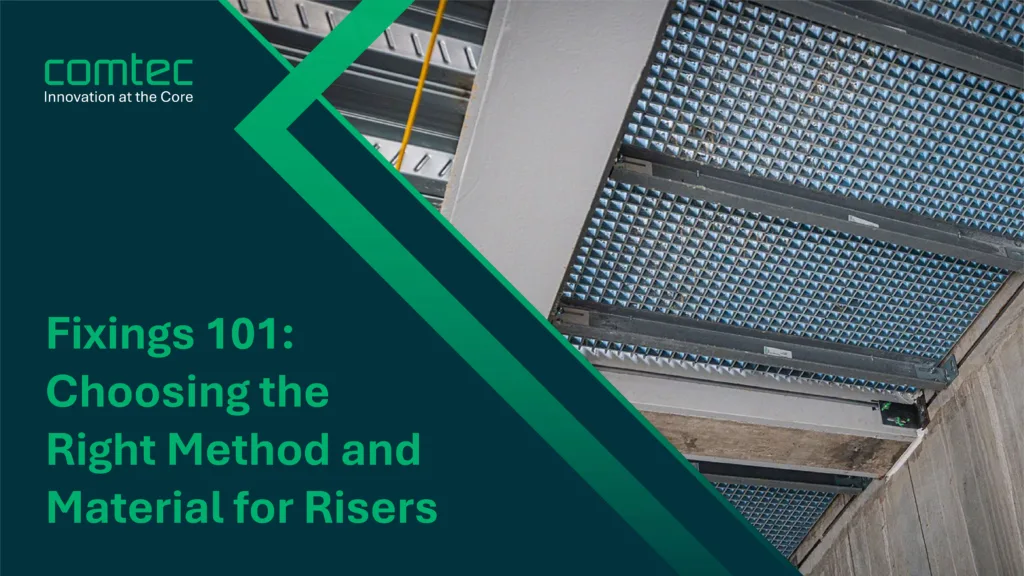
The AlphaRiser system was created precisely to address the challenges of late riser design. Developed by Comtec after years of seeing clients struggle with uncoordinated riser apertures, it provides a complete, cast-in riser management solution.
Because AlphaRiser is pre-manufactured off site, it offers factory precision and immediate on-site safety. Its unique channel design allows services to be fixed directly without drilling, while joist positions can be slid or added along the channels at any time – an invaluable feature when M&E layouts inevitably change.
By being designed-in early, AlphaRiser eliminates the need for:
- Site-formed shuttering and temporary protection
- Secondary fixings for service supports
- Hot works or invasive adjustments later in the build
The result is a strong, lightweight, and fully protected unit that integrates perfectly into the structure and supports the project’s evolving design – a genuine example of design coordination adding measurable value.
From Risk to Readiness
Early riser design coordination transforms what was once a risk zone into a point of readiness. Rather than working around voids and uncertainties, site teams can work safely and efficiently from the first pour. Mechanical and electrical trades gain a consistent, ready-to-use interface, and the overall programme benefits from reduced rework and clearer sequencing.
AlphaRiser makes this possible – converting the unpredictable into the planned, and the hazardous into the safe.
Conclusion
The success of modern high-rise construction depends on coordination – and riser management sits at its core. By engaging early, aligning structural and service design, and specifying a system that’s purpose-built for flexibility and safety, projects gain not only efficiency but confidence.
Choosing to design in AlphaRiser at the outset isn’t simply about selecting a product. It’s about making an informed decision that supports every trade, every stage, and every aspect of successful riser management.
Next Steps
The team at Comtec are striving to reduce risk, waste, and inefficiency in riser management. Engaging with us as early as possible in the design process (RIBA Stages 2–3) can help inform decision-making for significant elements, even affecting core and floor slab construction methodology. Reach out directly for a free design consultation.