In the fast-moving environment of modern construction, change is inevitable. The design and positioning of MEP services evolve, client requirements shift, and coordination between trades must continually adapt. But few areas feel the impact of these changes more acutely than the riser voids – the vertical spaces that carry the lifeblood of a building’s mechanical and electrical systems.
When riser design is left unresolved until late in the programme, every adjustment has a ripple effect. What seems like a minor design revision can quickly translate into substantial cost, delay, and risk on-site.
The True Cost of Rework
Rework is one of construction’s most persistent sources of lost productivity. In the case of risers, the causes are familiar:
- Openings formed too early or in the wrong position
- Joist supports need to be moved to reflect the final service positions
- Not enough joists or supports installed, so more need to be added
- Unclear or incomplete M&E coordination at the time of slab pour
- Lack of structural provision for service supports
- Safety issues caused by unprotected voids
- Firestopping systems unable to integrate with last-minute solutions
Each of these issues demands corrective work. Cutting and patching concrete, installing ad hoc support systems, or fabricating bespoke covers after the fact – all introduce additional cost, disrupt sequencing, and compromise quality.
Often, riser deck systems are being replaced in their entirety due to the significant changes needed to reflect the final riser design. This multiplies the riser cost, creates additional risk on site, and delays the programme – usually affecting areas on the critical path.
Moreover, rework in riser voids carries disproportionate risk. These are vertical penetrations through multiple floors – meaning that any delay, defect, or safety lapse affects multiple trades and stages simultaneously.
Late Design = Early Problems
The irony is that most of these issues stem from a simple oversight: the assumption that riser design can wait until services are finalised. In reality, delaying the decision only pushes complexity downstream. By the time M&E drawings are approved, the concrete structure is often complete – and the opportunity for a coordinated solution has passed.
At that point, the project faces a choice: either rework existing apertures at significant cost, or compromise with a makeshift post-fix solution. Both options erode the efficiency, safety, and professionalism that clients rightly expect.
The Smart Alternative: Design Early
The most effective way to avoid rework is to eliminate the cause by treating riser management as a design package in its own right, rather than a by-product of structure or services.
When coordinated early, the riser design can be cast into the structure with precision, incorporating the necessary flexibility to accommodate later adjustments. This approach reduces downstream risk and transforms the riser from a problematic void into a ready-to-use interface.
Where AlphaRiser Changes the Equation
This is precisely what AlphaRiser was developed to achieve. Created by Comtec after years of seeing projects absorb unnecessary rework, AlphaRiser provides a complete, cast-in riser management system that builds flexibility into the structure itself.
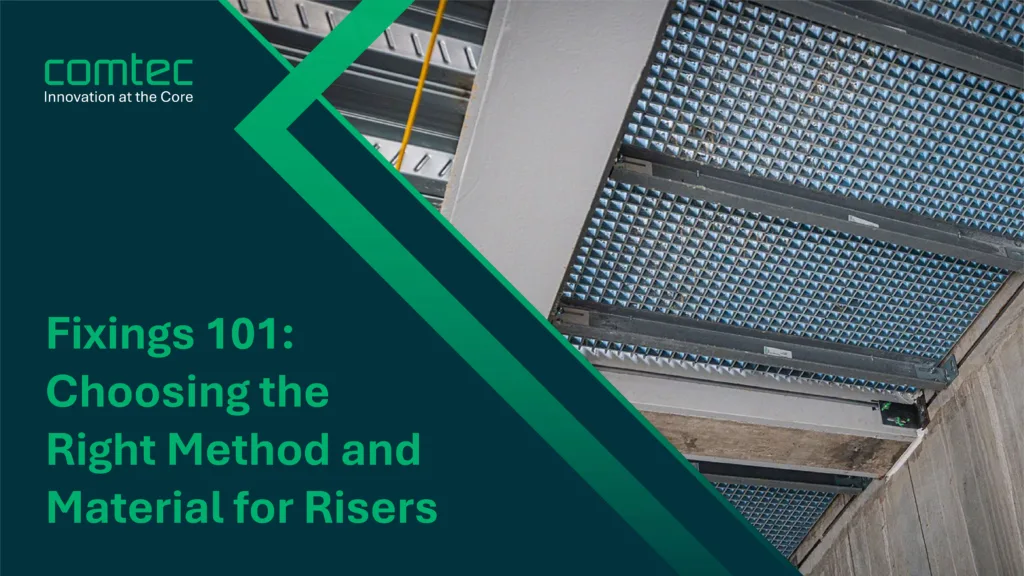
Because AlphaRiser units are fully manufactured off-site, they arrive on site pre-floored, protected, and ready for immediate installation. Their unique steel channel design allows supports for services to be slid or added as layouts change – meaning that the system naturally accommodates the design evolution that so often derails traditional riser approaches.
Key advantages include:
- No temporary formwork or protection required
- No drilling or hot works to install services
- Adjustable supports that adapt to late design updates
- Immediate safety for site teams – no open voids
- Reduced rework, waste, and programme impact
In short, AlphaRiser converts uncertainty into readiness. By integrating flexibility from the outset, it protects the project from the high cost of change.
Counting the Hidden Savings
The financial benefits of avoiding rework are rarely captured in tenders – yet they are real and measurable. Consider the cumulative savings:
- No temporary shuttering or core drilling through the concrete slab
- No installation of temporary protection
- No duplication of service fixings
- No programme delay or associated prelim costs
- No temporary access requirements
- No hot-works permits
These avoided costs, combined with improved safety and quality assurance, often exceed the initial investment in a well-coordinated riser system.
Conclusion
Late design changes are an unavoidable part of construction – but their impact on riser management doesn’t have to be. The key lies in foresight: designing flexibility in, rather than paying for it later through rework.
By specifying AlphaRiser early in the design phase, projects gain a ready-made solution that adapts with them – maintaining safety, minimising waste, and delivering the efficiency that modern construction demands.
When viewed through the full lens of project cost, the most economical riser is the one that never needs rework.
The team at Comtec are here to help minimise risk, waste, and inefficiency with riser management. We recommend engaging with us at RIBA Design Stage 3 to ensure that all the significant benefits of the AlphaRiser system can be leveraged. We’d love to hear from you.